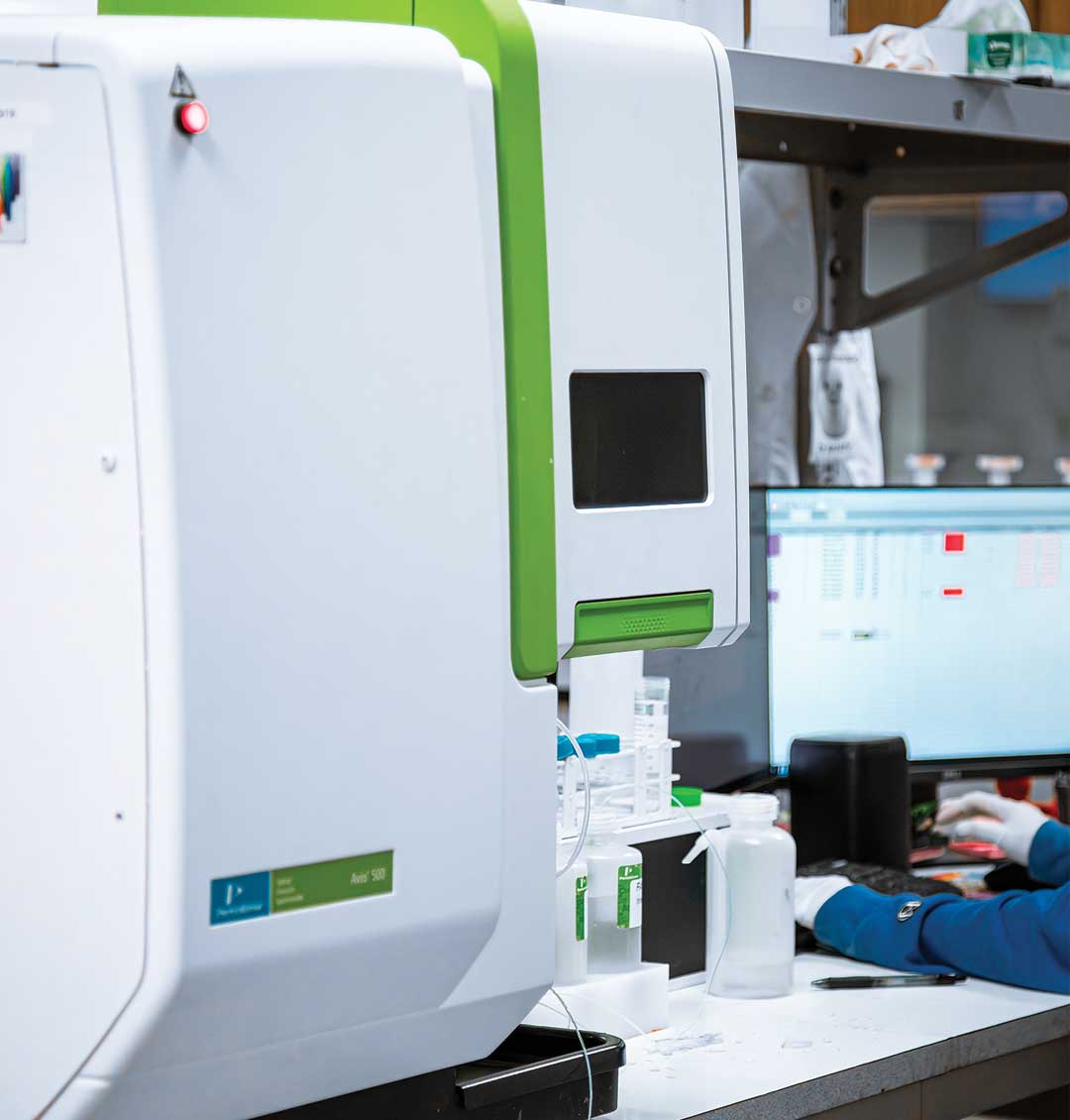
Inductively Coupled Plasma (ICP) testing is one of the industry-leading methods for testing the elemental composition of a material. ICP utilizes one or both of two techniques (ICP Mass Spectrometry or ICP Optical Emission Spectrometry) to precisely detect and measure elements in a wide range of materials from advanced metal alloys and ceramics on airplanes, to pharmaceuticals and cosmetics.
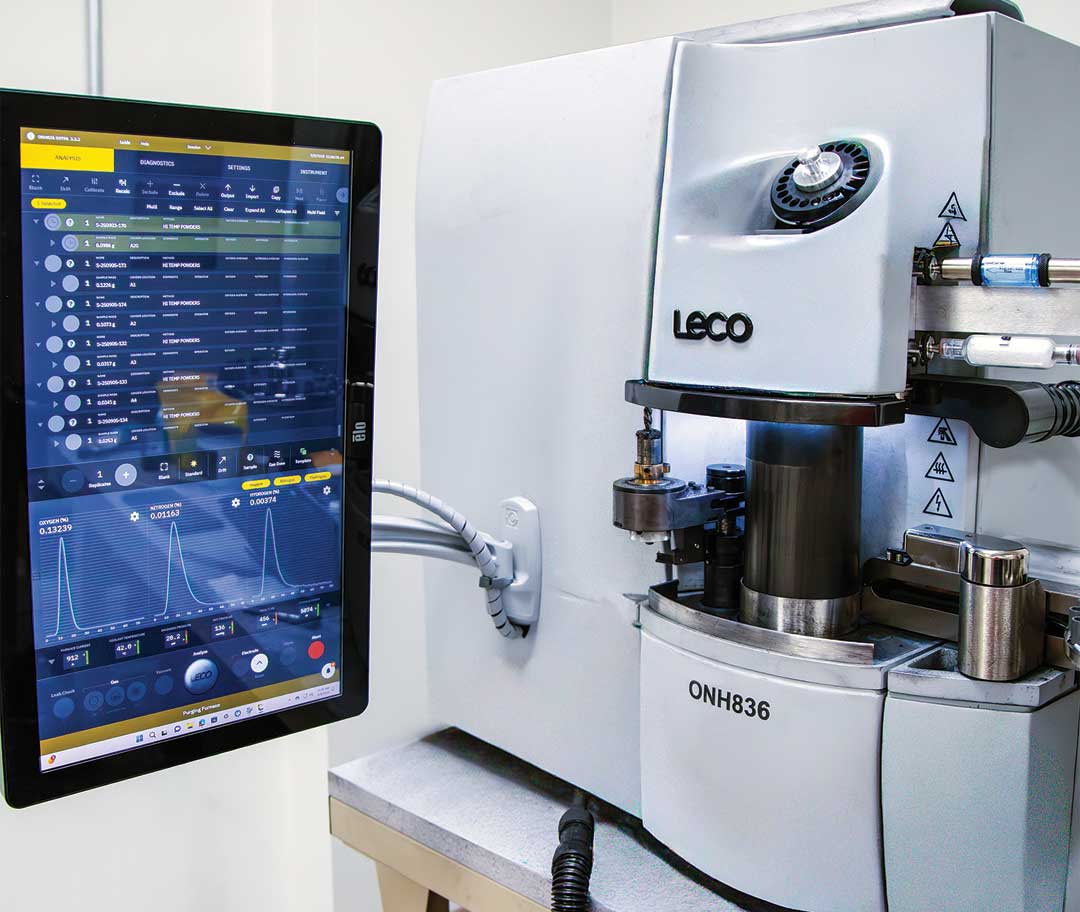
LECO testing is the common brand name for equipment that utilizes Combustion Analysis or Inert Gas Fusion to identify specific light elements that are generally not measurable by ICP. In combination, ICP and LECO form the gold standard of elemental testing for quality control.
Inductively Coupled Plasma (ICP) analysis and LECO (which includes Combustion Analysis and Inert Gas Fusion) testing are two of the industry-leading methods for testing the elemental composition of a wide variety of materials-from advanced metal alloys and ceramics on airplanes to pharmaceuticals and cosmetics. Each method brings a unique capability to accurately generate compositional information on most material systems.
ICP is capable of detecting bulk and trace elements across the majority of the periodic table, while LECO is used to detect light elements, like oxygen and nitrogen, that ICP is unable to measure. When used together, they provide nearly the whole spectrum of elements from bulk to trace levels, ensuring a high confidence of material quality and regulatory compliance.
These techniques are essential tools for engineers and manufacturers, offering fast, accurate and repeatable results and require only a small amount of test material. As a result, they enable enhanced quality control and assurance at every stage of the production cycle, from raw materials to end products.
What Are the Methods and Principles Behind ICP Testing?
Depending on the required detection range (the percent of an element of interest, from bulk to ultra-trace), ICP testing utilizes one or both of two techniques to precisely detect and measure elements in a wide range of materials. If the sample is initially solid, it is first dissolved in an acid to form a liquid solution. Each technique involves vaporizing, atomizing, and ionizing the liquid sample by injecting it into an argon plasma formed by a radio frequency generator, known as an Inductively Coupled Plasma, or ICP.
Optical Emission Spectroscopy (ICP-OES), otherwise known as Atomic Emission Spectroscopy (ICP-AES), operates on the principle that excited atoms emit light at specific characteristic wavelengths. In this technique, the liquid sample is injected as an aerosol into the plasma, where the intense heat vaporizes the sample and ionizes the atoms therein. When the ions return to their ground state, they release the energy as photons of light, whose intensity is measured with photomultiplier tubes (PMTs) or charge-coupled devices (CCDs). The wavelength of an emitted photon is characteristic of the specific element, while the intensity is proportional to its concentration. This allows for accurate, quantitative analysis of a wide spectrum of elements simultaneously.
Mass Spectrometry (ICP-MS) combines the high-temperature ionization capabilities of ICP with mass spectrometer detection. It is similar to ICP-OES in that the sample is introduced into an argon plasma to be atomized AND ionized but is unique in that this method directly measures the ions the plasma produces.
The charged ions are then extracted through an interface (typically a pair of water-cooled cones) and directed through ion optics (electrostatic lenses) that guide the ions into a mass analyzer where the ions are separated and measured based on their mass-to-charge ratio, or m/z value. The signal generated is directly proportional to the relative concentration of the element in the sample, which is converted to a concentration by comparing it to a calibration standard of a known value.
How Does LECO Testing Work in Elemental Analysis?
While powerful in its breadth of elements and range of detection limits, ICP is not capable of detecting all elements. This is where LECO testing comes in, which is the common brand name of equipment for methods that utilize Combustion Analysis or Inert Gas Fusion to identify specific light elements in a sample that are generally not measurable with ICP, namely for C, S, O, N, and H.
Combustion analysis heats a small sample to a high temperature in an oxygen-rich environment, converting carbon and sulfur into their gaseous oxides, like CO2, which are measured using an infrared absorption detector (NDIR).
Inert gas fusion heats the sample in an inert atmosphere like helium or argon to release nitrogen, oxygen, and hydrogen. These elements are then processed through a series of catalysts, detectors, and scrubbers to independently analyze the constituent elements.
Why Are ICP and LECO Testing So Valuable to Manufacturers?
Simply put: they are the gold standard of elemental testing for quality control.
These testing methods help ensure that the raw materials and finished products meet precise specs for elemental composition. This is a key consideration for performance-critical industries like aerospace and defense, automotive, and medical devices, because in today's world, we are constantly demanding more from our materials, and even the smallest out-of-spec variations in trace elements like carbon or sulfur content can impact the material's properties and fitness-for-use, ultimately undermining the safety or performance of the product.
Accurate and repeatable elemental analysis allows manufacturers to meet strict compliance and specification targets through each stage of the product lifecycle, whether it is R&D, quality assurance, or failure analysis. While invaluable in making sure elements are present in the appropriate concentrations in alloys and materials, they are equally useful in ensuring contaminants like oxygen or sulfur in alloys or dangerous elements like lead or mercury are absent or below acceptable limits for medical or consumer-facing products.
While there is no one-stop-shop test that covers all elements, as ICP and LECO each specialize in detecting different element types, utilizing both techniques provides a complete picture of your material, boosting confidence in your product and ensuring it meets all quality specifications.
Authored by Dr. Ross Cunningham, Director of Science and Technology, NSL Analytical Services, Inc.
For more information contact:
Dr. Ross Cunningham
Director of Science and Technology
NSL Analytical Services, Inc.
Cleveland, OH
rcunningham@nslanalytical.com
www.nslanalytical.com